
Deep dive – Ion Beam Applications (IBA)
1-week PoC IBA boosted efficiency by 66%
Learn how the medical device leader in Proton Therapy, Ion Beam Applications (IBA), discovered troubleshooting efficiency with the 1-week Proof of Concept.

IBA (Ion Beam Applications S.A.) is the world leader in particle accelerator technology. The company is the leading supplier of equipment and services in the proton therapy field, considered the most advanced form of radiation therapy available today. IBA is also a leading player in the fields of industrial sterilization, radiopharmaceuticals, and dosimetry. The company is based in Louvain-la-Neuve, Belgium.
The challenge
How a One-Week PoC Led IBA to Choose Dezide
This article provides an in-depth overview of Ion Beam Applications’ (IBA) successful one-week Proof of Concept (PoC) with Dezide, which ultimately led to IBA selecting Dezide for its AI-driven field service troubleshooting needs.
IBA leveraged the PoC findings to build its business case and confidently decide on a full rollout. Regardless of the outcome, the process was a collaborative learning experience.
66% faster troubleshooting
Precision AI for Service
Problems solved on first try
Issues resolved outside areas of expertise
Fewer dispatches
Improved Efficiency
IBA uses AI troubleshooting in field service to:
Increase skill flexibility
Transfer skills to new talent
Reduce troubleshooting time
66%
faster troubleshooting
IBA combines its expert knowledge with our AI
Background
Potential and Expectations
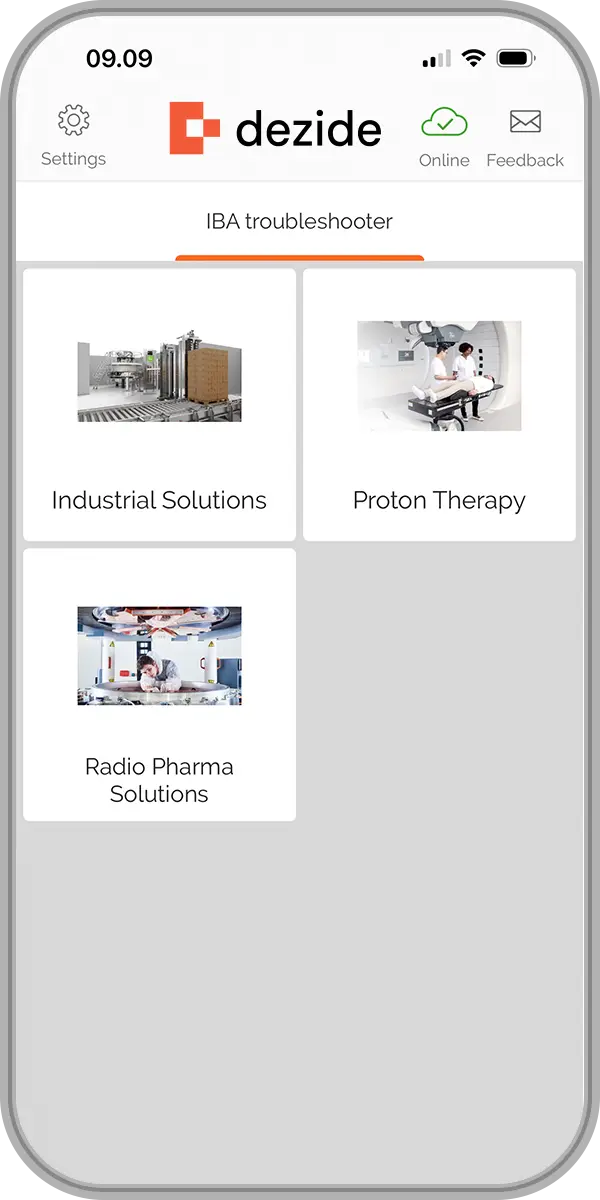
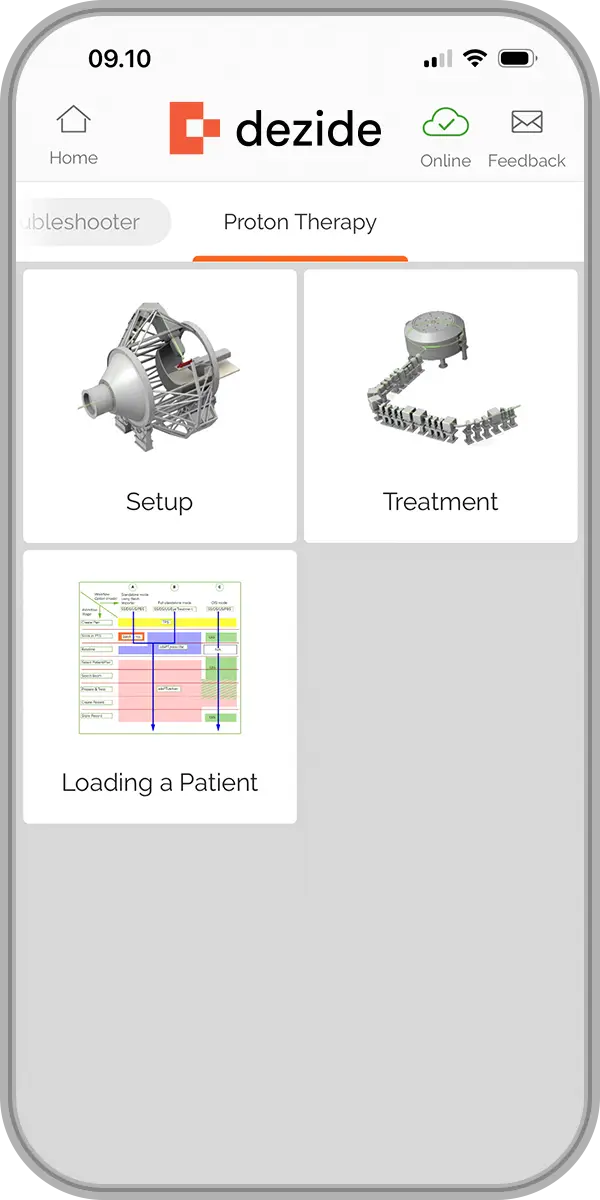
The Proof of Concept is executed within the Industrial Solutions Business Unit at IBA, with the business unit Proton Therapy exploring the functionalities of Dezide as well.
A new technician works alongside an experienced colleague for 6–12 months before they are ready to go into the field alone. The PoC evaluates whether a knowledge base tool can shorten new technicians’ training and education time and enable all regions to troubleshoot better and more precisely, even across multiple business units and product divisions.
The expectation is that using Dezide will result in the following:
Improved training of new technicians
If IBA can optimize and shorten the training period of new technicians without compromising quality, it can gain increased productivity, reduce costs, and accelerate revenue generation.
Reduced time spent troubleshooting
It would be very interesting if the troubleshooting time could be reduced by gathering the experts’ knowledge in one place, ensuring that everyone uses the same optimized source for troubleshooting.
Transfer of skills and upskilling
In regions with considerable employee turnover, it would be expected that a tool like Dezide could make Field Service employees troubleshoot more issues independently and more precisely.
PoC
When is the PoC a success?
The first task during the PoC was to establish the success criteria. This ensures we are all on the same page and know what to expect from the PoC:
The expectation is then that using Dezide will result in the following:
Prove that using Dezide can shorten training time for new technicians.
Prove that new or less experienced techs can troubleshoot issues faster than today using the troubleshooting guides built in Dezide.
Prove that using Dezide can instantly transfer knowledge to the entire workforce, allowing all technicians to troubleshoot multiple issues as experts, even outside their skill set and work area.
Proof
“Working with Dezide has been an invaluable experience for IBA. They have consistently shown remarkable thought partnership and brought troubleshooting expertise.”
Marc Van der Burght
Chief Operating Officer of IBA
Step 1
Pre-workshop Kick-off Meeting
Before the workshop in Ottignies-Louvain-la-Neuve, we conducted an online pre-workshop meeting using Teams. The goal of this meeting was to get everyone introduced and ensure we were aligned on the practicalities of the on-site workshop.
We talked about what and where for the workshop. We also discussed that Industrial Solutions would be the main subject of the PoC and that Proton Therapy (PT) would like to explore the data import functionalities of Dezide, observe, and be part of the workshop to learn more about the Dezide system and its capabilities.
It was quickly established that proper test facilities could be found at the Indux-Center and that IBA would go back and prepare some cases for troubleshooting, and plan and book time for the live tests.
Duration: 1:00 hour
People from IBA
Product Owners
Enterprise Architects
Application Specialists
Program Managers
Directors of Operations & Tools
People from Dezide
Business Developer
Project Managers
Step 2
On-site Workshop & Guide Building
During the on-site workshop, we built the troubleshooting guides for the issues that were selected previously and that we could test during the workshop days.
The focus of the workshop was not for IBA to learn how to use all the features of Dezide, so the Dezide consultants Lasse and Steven facilitated the guide-building process and built these guides after the daily workshops were complete, so the guides would be ready and usable for the two live testing days.
Building guides in Dezide requires that you know a little bit about the knowledge model concept that lies behind the Dezide methodology, so a little time was spent introducing the methodology before we went to the whiteboard to start building the first guide:
Duration: 2 days
Common for all guides was that they had very good images and documentation. If images were missing, the team went to the equipment and took the required pictures.
A total of three troubleshooting guides were built during the build phase:
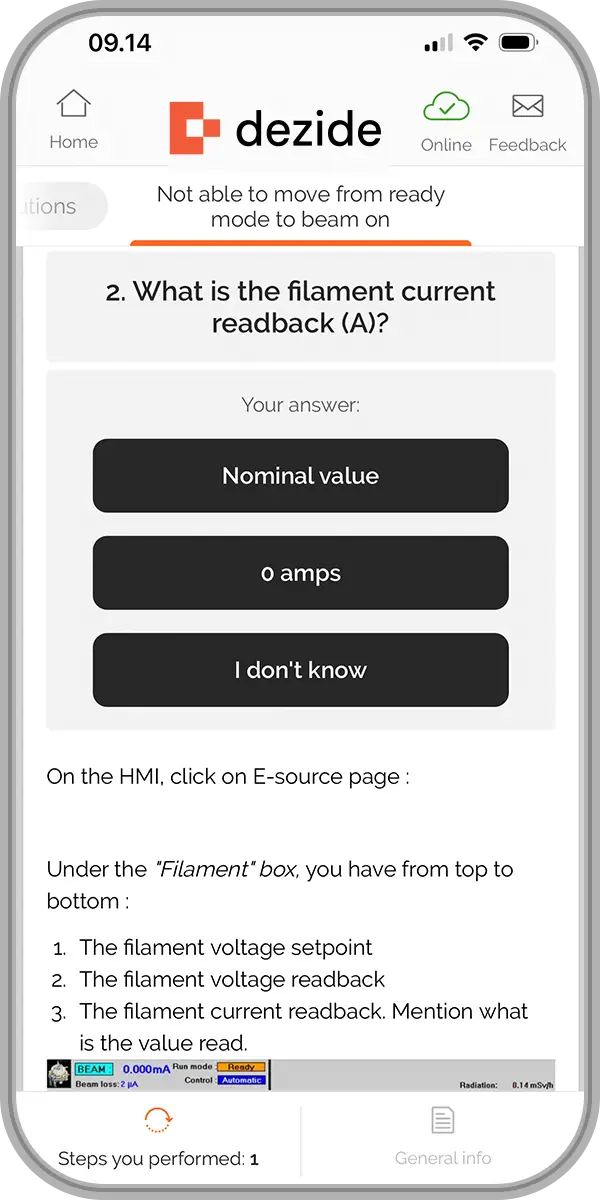
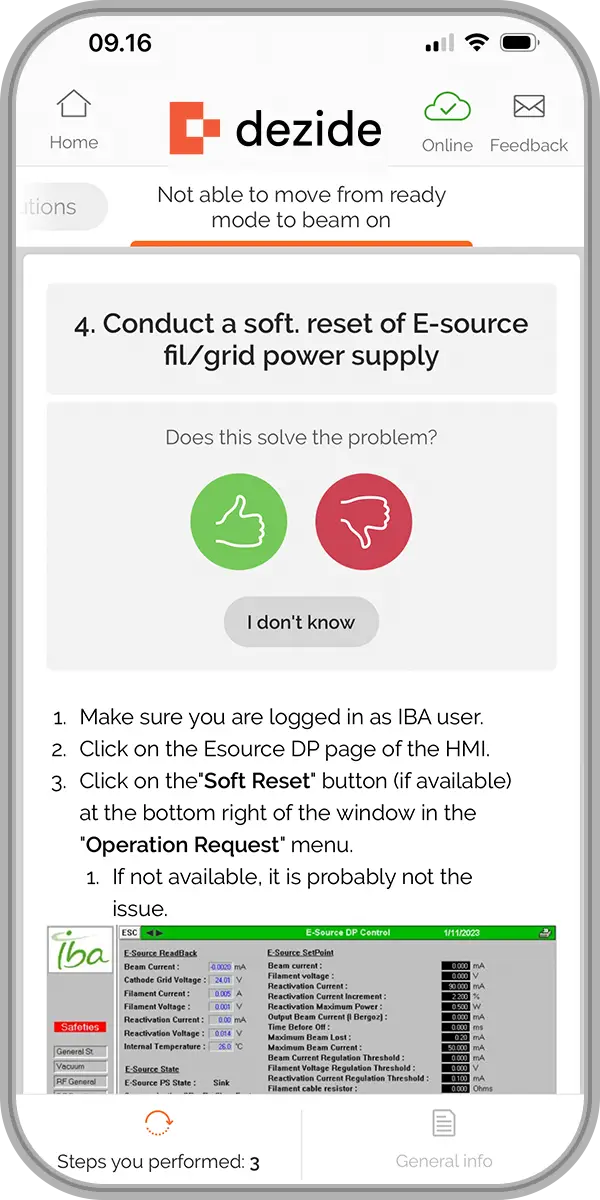
Not able to move from ready mode to beam on
A large, comprehensive guide solving a complex issue with the beam not turning on.
- 18 causes structured in a hierarchy
- 18 solution actions
- 7 symptom questions
- 1 configuration question
The scanning magnet P.S. ‘ready’ light does not switch on
A smaller but highly efficient guide offering solutions without asking too many questions.
- 11 causes
- 11 solution actions
- 1 symptom question
- 1 configuration question
Not able to connect technician laptop to HMI
A large guide for solving IT problems with comprehensive explanations for a great user experience.
- 15 causes
- 15 solution actions
- 2 symptom questions
- 1 configuration question
Step 3
Live Test
Testing was planned to take place in the INDUX Center. Here, the needed tests were set up, and we ensured the guides and explanations used were suitable for the testing scenarios. Having the test facilities at hand was very helpful, and everyone involved was very interested and participated in the preparation and testing of Dezide.
Everyone involved actively participated and joined the dialogue and testing sessions.
Test Results
In one area, the results show that we reduced the average time spent troubleshooting by roughly 33%, but perhaps even more interesting is that a technician solving these issues more efficiently was not an expert in this area.
In another area, the technician not using Dezide had to give up. The issue was outside his expertise, and he would have had to escalate it to another team to get it solved. On the same issue, but now using Dezide, the technicians could solve the problem. Even more interestingly, the technicians were inexperienced, and one was outside his area of expertise.
This is especially interesting because it shows that the technicians can solve the issues competently with limited experience, even when the issue is outside their area of expertise. The last test results revealed that new technicians, regardless of their area of expertise, could solve issues just as well as experienced field service technicians within the area of their expertise.
This is significant as companies across the service industry suffer from a lack of resources and must find a way to utilize them better.
Duration: 2 days
Testing Facts
16 planned tests completed
Tests conducted by Field Service division technicians (1 new, 3 expert)
And Automation division technicians (1 new, 1 expert)
Diverse skill levels represented across two business units
“In another area, the technician not using Dezide had to give up.”
“On the same issue, but now using Dezide, the technicians could solve the problem.”
Business impact analysis
Resource Gap and Skills↓
The service industry generally needs more technicians and, more importantly, skilled technicians. We have seen a paradigm shift from a mechanical industry to a more electrical and digital-focused industry, which puts a big strain on training and addressing the skill and resource gap in the industry.
During our Proof of Concept, the test results for the more complex issue related to “Scanning Magnet” showed that, with Dezide, the technicians could reduce the troubleshooting time significantly. It went on average from more than 30 minutes down to approximately 10 minutes!
We also saw an example of a technician without Dezide stating that this type of problem was outside their area of expertise and, hence, would have to call for help or have another technician resolve it. However, with Dezide, the issue was resolved, but more importantly – it was solved just as efficiently as the expert within that field of expertise.
This clearly has a big financial business impact, as we can demonstrate that with the right guidance, the technicians can solve the issues and solve them efficiently regardless of their skill level. It leads to fewer dispatches as issues can be resolved the first time, regardless of the technician’s area of expertise.
Downtime↓
We all know that time is money, which could be lifesaving in certain industries. If we can reduce the average troubleshooting time, as the PoC results clearly indicate, or eliminate the times a technician would have to dispatch another technician with a different skill set, it surely will have a significant impact on the customers’ bottom line. Time is recovered so that the customer can operate and perform the needed services instead of waiting for the equipment to become operational again.
Parts↓
Spare parts can be very expensive, and replacing parts that are not faulty is not only a waste of time but also a waste of money. During the IBA PoC, the focus was not on replacing fewer parts but on reducing troubleshooting time and transferring skills to other employees. As such, we didn’t see any parts being replaced due to the type of issues we focused on. What we did see was a dramatic reduction in time spent in one of the areas, which could lead us to conclude that for other areas, this can be converted to time wasted due to replacing parts that are not faulty.
Parts case study↓
The impact of spare parts optimization is incredibly significant, so we are including a small case study from another PoC here to highlight its importance. The goal of that PoC, which we conducted with a global manufacturer of industrial pumps, was to focus specifically on demonstrating the potential for reducing the amount of spare parts used with Dezide. This company was replacing too many good parts because the entire workforce did not have the proper troubleshooting knowledge at hand when in the field.
Two troubleshooting guides were built in Dezide, each addressing a specific issue, and they were tested in the training facilities, where the errors were introduced into the pump. Two teams of engineers solved the issues. Team One used the traditional methods they know and use today, and Team Two used Dezide. Using the traditional methods, the first team fixed the first issue by replacing the control box instead of a functional module, and the second issue by replacing the control box instead of a battery. The control box costs €1,400, the functional module costs €340, and the battery costs €10.
For the one product used in the lab test, the company currently replaces at least 400 control boxes per month – in many of those cases, replacing either the functional module or the battery would have solved the problem.
In this case, the yearly savings in reduced spare parts usage are significant (multi-million euros).
New revenue streams and customer satisfaction↓
Providing customers with new opportunities for better self-service will strengthen customer relations and open new revenue streams to boost sales. Dezide can be white-labeled as an IBA product, sold to end customers, or become part of a premium service product to enhance the customer experience further. Reports show that one of the biggest impacts of customer satisfaction – impact on Net Promoter Score – is how well you handle an issue a customer is experiencing. The results from the PoC clearly indicate that with Dezide, these issues can be handled quickly, efficiently, and competently by all technicians. This can further solidify customers’ strong and positive view of IBA.
Turn your best experts' troubleshooting into step-by-step guidance every technician can follow
Step 4
Presentation of Key Results
We’ve reached the project completion phase, and now it’s crucial to thoroughly assess the overall experience. This involves a comprehensive review of both quantitative data and qualitative user feedback. Specifically, we’ll focus on capturing the distinct experiences of administrators and end-users with the Dezide platform.
To facilitate internal discussions, we’ll compile a detailed report summarizing our findings. We’ll then schedule an online meeting, typically two weeks following the on-site workshop and live testing, to present the key results and insights from this report. This will provide a clear and actionable overview of the project’s impact.
The primary focus of the IBA PoC was on improved training time for new technicians, reductions in overall time spent on troubleshooting, and potentially a faster transfer of skills to new employees.
To deem the PoC a success, the testing should:
→
Prove that using Dezide can shorten training time for new technicians.
→
Prove that new or less experienced techs can troubleshoot issues faster than they do today, using the troubleshooting guides built in Dezide.
→
Prove that using Dezide can instantly transfer knowledge to the entire workforce, allowing all technicians to troubleshoot multiple issues as experts, even outside their skill set and work area.
Let’s look at them one at a time:
Duration: 1:00 hour
People
Project Manager
Management / Project Owner
Workshop Participants
Secondary Stakeholders
Using Dezide shortens training time for new technicians
During testing, we saw how using Dezide shortens training time for new technicians by providing a platform that offers a structured, organized, and step-by-step approach to assist new technicians. By breaking down complex tasks into smaller, more manageable steps and providing a structured approach to troubleshooting (and thereby learning), technicians can become familiar with their tasks more quickly and with fewer mistakes. Additionally, Dezide can help technicians retain information and apply it to their daily tasks. During testing, Dezide was found to help shorten training times for new technicians, resulting in more efficient onboarding and better overall productivity.
Dezide is designed to shorten training time for new technicians by using Bayesian networks to provide technicians with a logical and systematic way of diagnosing and resolving technical problems quickly and accurately. Specifically, Dezide guides technicians through a step-by-step process of asking questions and gathering data to arrive at a solution. This allows technicians to quickly identify the problem, diagnose it, and provide the necessary solution.
Using Dezide enables new technicians to troubleshoot faster and more precisely
Using Dezide allows new technicians to quickly and precisely identify the root cause of an issue. The platform guides the technician through the process of narrowing down the possible causes. By providing technicians with a step-by-step approach to troubleshooting, Dezide helps them quickly identify the issue and take corrective action. This saves time, increases efficiency, and reduces the amount of trial and error that may be required when using traditional troubleshooting methods.
We saw that an experienced technician who did not use Dezide went through the same steps as the guide asked for, which was exactly what we wanted. For an inexperienced technician, we saw that they went through many different steps in many directions, whereas the path in the guide was shorter.
Using Dezide for troubleshooting results in faster transfer of skills
Recruiting and training are rising problems. The 20-year tech is a thing of the past. Most service organizations now expect to get 3-4 years from a new technician before they churn. Managers say they should be happy if they get 3-4 years from them. That’s the gold standard now, so we must ensure those techs are as productive as possible during those 3-4 years. Despite that level of churn, the tech still needs to feel confident that he can access tools that reassure him that he can appear professional to the customer and strengthen the customer relationship. The only way to ensure this is to enable the instant transfer of skills from the experts to the new generations – or from experts in one field to experts in another.
The PoC tests clearly showed that the technicians could fix problems outside their expertise using Dezide. In one case, the FSE expert Sacha gave up after four minutes when trying to solve the “Virtual machine not started” issue. It was clearly outside of his working area, so he didn’t know what to do. Using Dezide, Sacha successfully fixed the problem with the stopped VM after nine minutes. That’s pretty good!
During the tests, it was discovered that certain checks for the relays and fuses could be replaced by asking a question about the “mains” light. The change would have replaced two actions in the guide with a simple symptom question. Time could have been reduced by somewhere between 5 and 15 minutes. This is an excellent example of improving the knowledge base and transferring new knowledge to the workforce. New knowledge instantly changes how the entire workforce handles that particular issue and instantly optimizes how issues are resolved across the service organization.
Another great example of how skills are instantly transferred from one generation to the next is the “stopped VM” issue. Here, we saw that Lucas, an expert in Automation, solved the problem in six minutes using his expertise and know-how, which is quite impressive! We then saw Antoine, a new employee in Automation, solve the same issue using Dezide in six minutes!
Step 5
Q&A & Get Started with Dezide
This is a follow-up meeting one week after the PoC report presentation.
We addressed any questions from the 1-week PoC report and discussed potential next steps, including the Dezide Implementation Framework for successfully rolling out Dezide to the workforce. The Dezide Implementation Framework is designed to support essential Change Management aspects of the roll-out, and it’s based on our 20 years of experience with this process.
Improving the results
While the results from the testing phase were impressive, there is plenty of opportunity to improve them through automation.
Data Collection / IoT
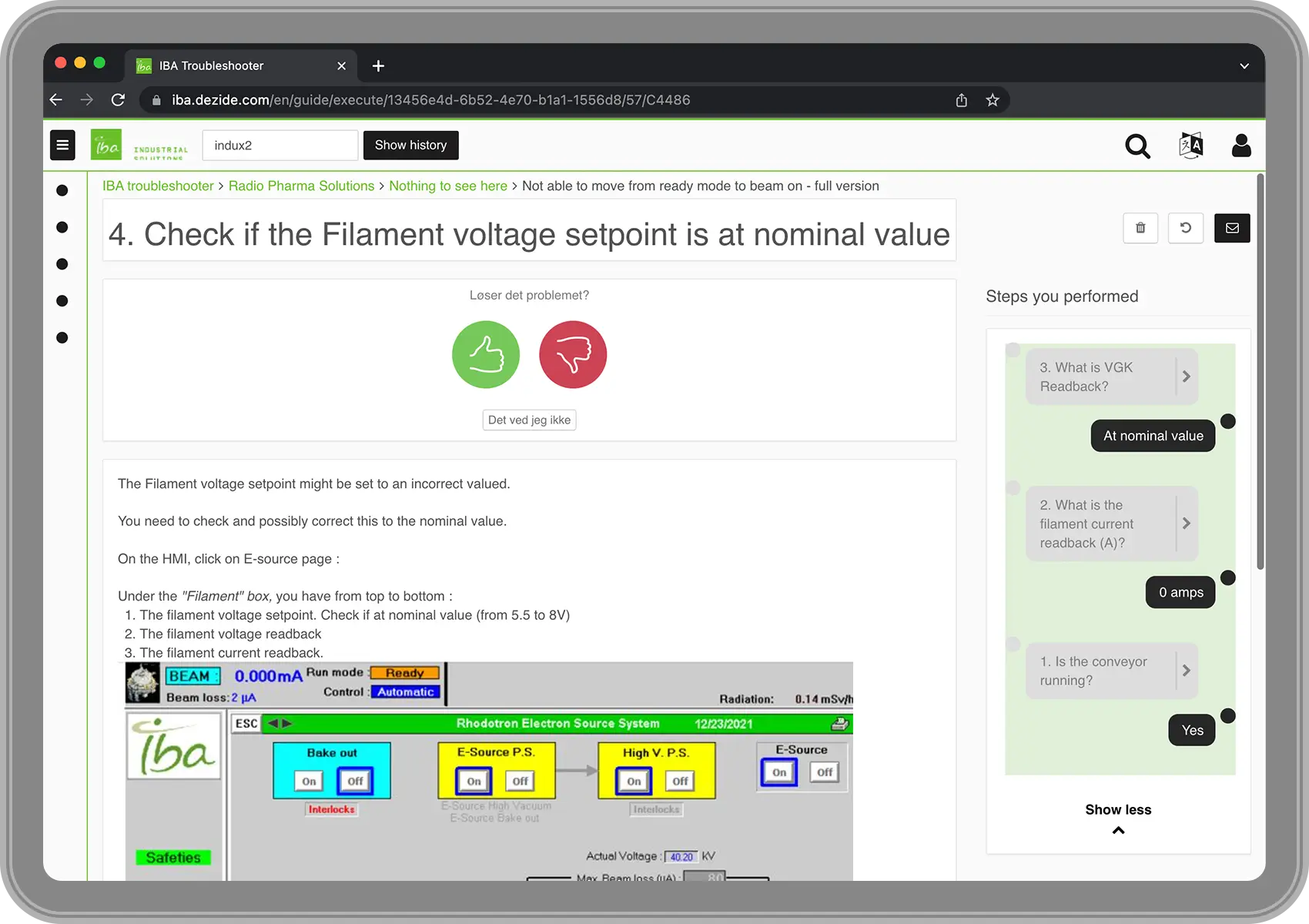
During the testing, it was impossible to test the data collection (IoT) feature of Dezide using real data. Basically, every time there is a question in Dezide, it can be answered automatically by the system using data. This ensures a very high level of consistency and precision in the troubleshooting process as it eliminates many complex manual evaluations of disparate data. However, we simulated DCF using static data to illustrate the impact automatically answered questions have on the troubleshooting experience. The screenshot above shows that the Troubleshooter takes the technician straight to the solution: “Check if the Filament voltage setpoint is at nominal value” based on the answers to the right.
The testing team could easily see the potential in using data, and we highly recommend that IBA (and all other customers) utilize the data collection feature as much as possible.
Summary
Overall, the PoC was a success. The team involved in the guide-building and testing phases did a tremendous job during the PoC week. Feedback from the users has been positive: easy to use, a faster way to resolution, and resolution of issues outside of their normal work area.
Three guides were built during the PoC, with the main guide logic being worked out on the whiteboard together with the experts and entered into the system by Dezide afterward.
A total of 16 tests were conducted:
→
Eight tests were performed using methods available today at IBA.
→
Eight tests were performed using Dezide.
←
→
Proof
“One of the key factors influencing IBA’s decision was the suitability of Dezide’s troubleshooting guide for the complex nature of IBA’s machines. Among the various solutions assessed, Dezide’s dynamic guides offered an efficient path to resolving issues, ensuring fast and effective troubleshooting.”
Marc Van der Burght
Chief Operating Officer of IBA