
Why Dezide · Onboarding
From pilot group to every technician
The decision is made. Now several hundred people in every region you operate have to change how they work. That is organizational work, and it is where most software rollouts stall.
Ion Beam Applications (IBA) went from a one-week Proof of Concept to more than 1,500 guides in daily use across the Americas, Europe, and Asia. The Dezide Rollout Framework that got them there is included in every engagement.
Rollout
Evaluation
✓
Proof of Concept
Does it work on our equipment?
✓
Pilot
What's the business case?
Partnership
3
Onboarding
How do we roll it out?
You are on step three. Steps one and two are on the
Evaluation pageWhy this matters
Software does not roll out by itself
You have watched this happen. A capable system gets bought, configured, launched, and most of the organization carries on exactly as before. CRM, ERP, field service management, knowledge bases. Making a tool available is a different job from getting it adopted.
The gap is widest with the people who matter most. A field technician already carries a phone full of apps. A new one has every reason to become just another icon.
Closing that gap takes preparation, a communication plan per stakeholder group, named owners for the knowledge base, and someone who keeps it going after launch week. That is a job with real hours in it. Most service organizations are not staffed for it, and that is the reason rollouts stall.
We do that part with you.
The Dezide Rollout Framework is 25 years of rollouts written down. Every one of them changed it, and you get the version all of them shaped.
25 years
Rolling troubleshooting software out to field service organizations
40 global rollouts
The largest with more than 12,000 technicians in the field
The case
IBA: three divisions, one global service organization
Ion Beam Applications is the world leader in particle accelerator technology and the leading supplier of proton therapy systems. Their machines treat cancer patients. Every minute of downtime lands on someone's treatment schedule.
6 to 12 months
Training a new technician alongside an experienced colleague before they could work alone.
Thousands of pages
Static documentation holding the diagnostic knowledge.
Three regions
Americas, Europe and Asia, plus a Technical Support Center.
Specialist silos
Technicians could not troubleshoot outside their own sub-system.
IBA started with a one-week Proof of Concept. It measured 66% faster troubleshooting, and a new technician solving a complex fault in six minutes at the same speed as the expert beside him.
Read the PoC results →What follows is what happened after that week. The rollout.
✓
Whether you build construction equipment, wind turbines, or industrial machinery, the machines differ, but the shape is the same.
Complex systems, technicians spread across regions, diagnostic knowledge held by a handful of experts, and a ramp measured in months.
The split
IBA brought
✓
The product knowledge. Nobody else had it.
✓
Product owners, enterprise architects, application specialists, program managers and directors of operations, involved from the first workshop.
✓
Their own internal communication and rollout plans.
✓
The plan for the knowledge base itself: scope per division, build order, and their own dashboards tracking progress against it.
✓
Videos and e-learning to introduce the tool, produced in-house.
✓
On-site training sessions for the field.
Dezide brought
✓
The Dezide Rollout Framework: roadmaps for each phase, and the alignment questions that make a plan fit your organization.
✓
Guide Builder and the causal troubleshooting engine.
✓
The Knowledge Value Chain, so ownership of every piece of knowledge is explicit.
✓
The Confluence integration.
✓
Measurement design, and expectations about how adoption curves actually behave.
✓
A rollout specialist through the whole engagement.
IBA ran their internal communication themselves. That is usually the right split. You know your organization, your regions and your managers. We know which questions to ask and what tends to go wrong.
The knowledge value chain
Acquire. Validate. Share.
Dezide's process for turning expert troubleshooting knowledge into guides your field engineers trust, refined over 25 years with the world's leading service organizations.
The result is a knowledge base that helps your engineers solve problems faster and look like the experts they are.
1
Knowledge
Acquisition
Identify, capture and mature expert knowledge.
Quality assurance
2
Knowledge
Validation
Structure, standardize and organize it into guides.
Release
3
Knowledge
Sharing
Publish to the technicians who need it, then feed their experience back in.
Refinement / Feedback
Read more about the Knowledge Value Chain in this blog post ↓
Knowledge Value Chain – the operational model behind high-quality troubleshooting knowledge bases.The knowledge base
Where the guides come from
A troubleshooting guide draws on two things. Your documentation, which describes how the machine is built and works. And your experts, who know how a fault is actually narrowed down. The first one you already have. The second one lives in a handful of people's heads.
IBA built more than 1,500 guides from both. It was a planned program of work with scope, owners, and a schedule, and it ran across three divisions.
1
Expert reasoning, captured
Your manuals describe the machine, but they rarely describe how your best technician gets from a symptom to a cause. Guide Builder captures that reasoning as a causal model, working with your experts. This is the part that only comes from your people, and it is what makes a guide diagnose rather than describe.
2
Documentation, reused in place
IBA and Dezide built a Confluence integration. Pages in Confluence link directly to steps in Dezide guides and display to the technician in the field. One source, used in many guides. When engineering updates the page, the field sees the current version straight away, so the guide and the documentation stay in step.
3
Planned across three divisions
IBA mapped the whole knowledge base before building it. Radio Pharma Solutions, Proton Therapy and Industrial Solutions each got an agreed scope, assigned work and a build order. The Knowledge Value Chain is what makes that plan possible. It defines who captures each piece of knowledge, who validates it, and who publishes it.
4
Tracked to completion
IBA built their own dashboards showing the target for each division and the live count against it. More than 1,500 guides exist because every part of the organization had a number and somebody was watching it.
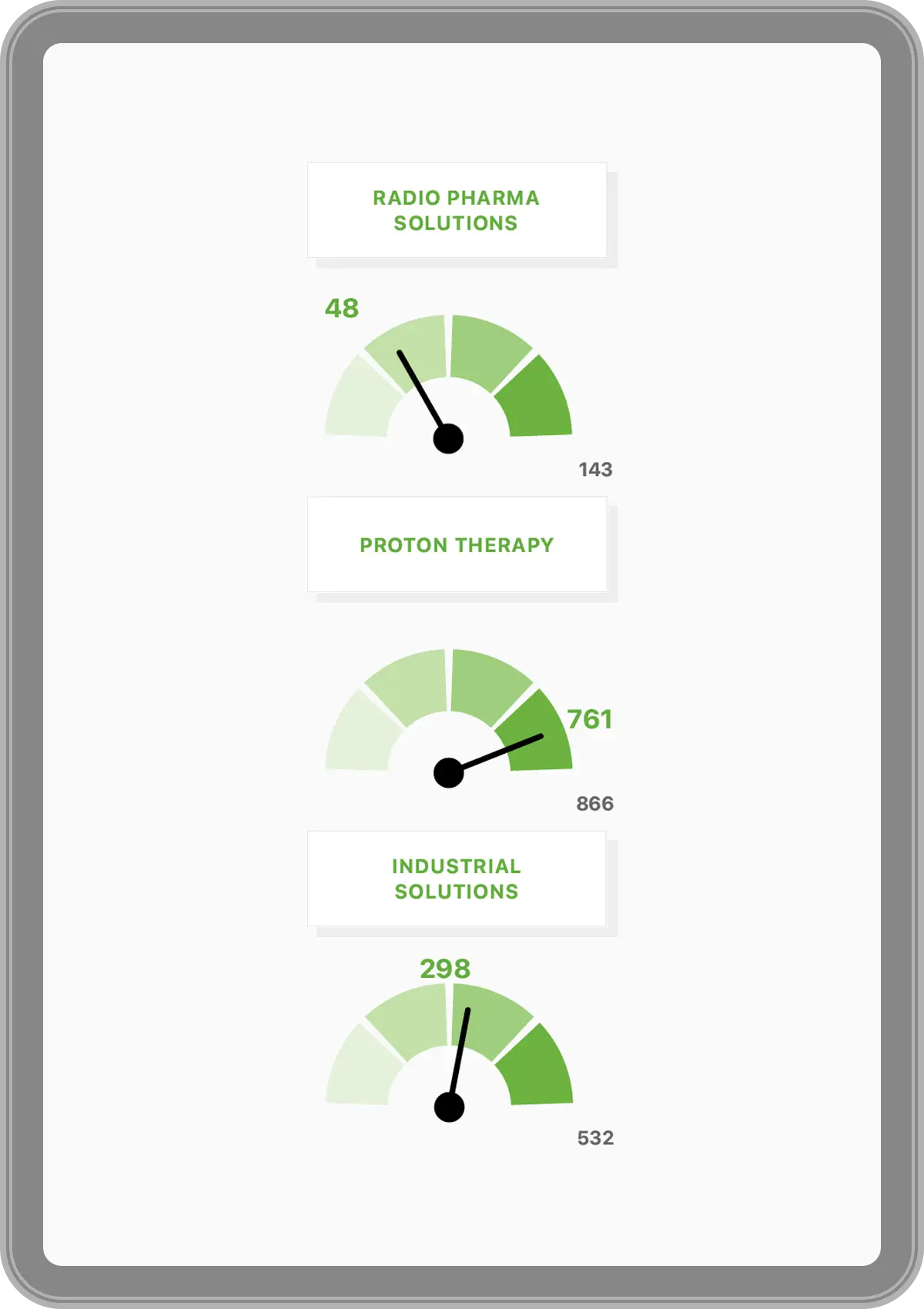
IBA's own tracking, part way through the build. Every division had a target and a live count against it.
The Dezide Rollout Framework
Six phases. Each one ends with something that exists
The process flows from one phase to the next. In practice, they overlap. Once the first technicians have the Troubleshooter, feedback runs through all six at once.
No plan survives first contact intact. The roadmaps, and knowing which questions to ask before kickoff, are how you stay ready when it does not.
1
Initiate
We do
Align on what is driving the project, who is involved, what success means, where to start, and how fast to add locations.
You do
Bring the answers and a decision maker.
You end with
Agreed driving assumptions and success criteria, a project organization chart, milestones and a roadmap.
2
Knowledge Value Chain
We do
Help you set up the back office process for acquiring, validating, and sharing troubleshooting knowledge.
You do
Name owners. One person is enough to start. Build the knowledge base.
You end with
Explicit ownership of who captures what, a validated first release, and a routine that keeps the knowledge base growing.
3
Integrate
We do
Connect Dezide to your service IT landscape. Authenticate and provision from your identity provider, collect machine-state data through the Data Collection framework.
You do
Give us access and an IT counterpart.
You end with
Users provisioned automatically, and a decision on how deep the integration goes. At IBA this is where the Confluence link was built.
4
Distribute
We do
Help you get the software into the hands of users and support the behavior change.
You do
Open the channels. Some already exist. Some you build.
You end with
A communication plan per stakeholder group, and technicians who know why this is happening.
5
Insights
We do
Design the measurement. KPIs and reports, plus adoption and field feedback.
You do
Agree what counts as success before launch.
You end with
Reporting you can trust and a usage curve you can explain to your board. At IBA, that feedback now drives spare parts forecasting and shows where regional training is needed.
6
Reinforcement
We do
Keep the change from decaying. A few clear, observable behaviors, plus longer-term work such as running guides directly on the machines and managing multiple brands.
You do
Stay in it. This is the phase most projects quietly skip.
You end with
A way of working that survives the next reorganization.
Grounded in standard change management practice. Understand, plan, implement, communicate, sustain.
Did they use it
IBA surveyed the technicians
Rollout numbers are easy to produce. Licenses issued, sessions logged, guides published. The question actually is whether the people in the field have changed how they work. IBA asked them.
63%
confirmed the platform increased skill flexibility in their team.
69%
reported better knowledge transfer across groups
56%
resolved issues faster
56%
fixed issues correctly on the first attempt
IBA field service technicians, global survey
“The troubleshooting tool has helped during several downtimes at the site and is easy to browse.”
“I believe this has helped direct us during trouble shooting in ways we probably would not have gone before. For the better.”
“Some of the proposed solutions provide interesting context that can help better understand what's happening. Keep up the good work!”
Proof
“We expected it to make troubleshooting faster. What we did not expect was to find out why our own service strategy was not landing. We could see where our technicians actually got stuck. That turned it from a tooling decision into a number our management looks at.”
Marc Van der Burght
Chief Operating Officer, IBA
Why Dezide?
Tell us about your service organization
A call with a rollout specialist. We will walk through your locations, regions, and dealer setup, and show you what the first months would look like, including the parts we think will be hard.